Daily Calorie Calculator: How Many Calories Do You Need?
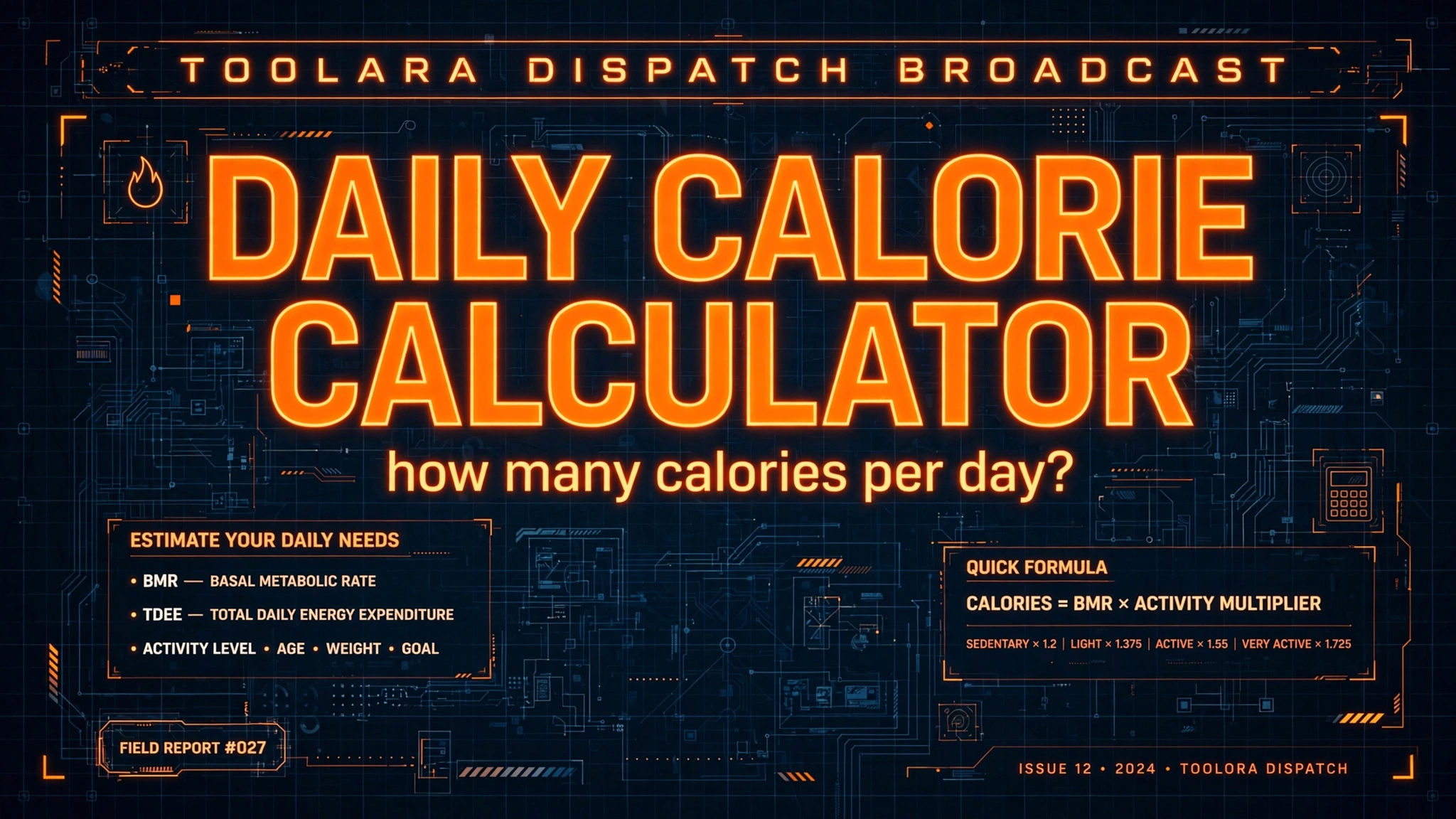
Knowing exactly how many calories your body needs is the foundation of every successful nutrition plan. Whether you want to lose fat, build muscle, or simply maintain your current weight, a daily calorie calculator removes the guesswork and gives you a personalized target number based on real science.
A daily calorie calculator estimates how many calories your body needs based on your age, sex, height, weight, and activity level. Most adults need between 1,600 and 3,000 calories per day to maintain their weight. Adjusting this number up or down helps you reach specific goals like weight loss, muscle gain, or maintenance.
Daily Calorie Calculator: What It Is and Why Your Number Matters
A daily calorie calculator is an online tool that calculates the precise number of calories your body burns in a 24-hour period. This figure — known as your Total Daily Energy Expenditure (TDEE) — represents the energy you need to consume to keep your weight stable. Eat more, and you gain. Eat less, and you lose.
Most people drastically over- or underestimate their calorie needs. Common assumptions like "everyone needs 2,000 calories" ignore critical variables such as:
- Age — metabolism slows roughly 1–2% per decade after age 20
- Sex — men typically need 300–500 more calories than women due to higher muscle mass
- Body composition — muscle burns more calories at rest than fat
- Activity level — a desk worker may need 600+ fewer calories than a construction worker
- Health goals — fat loss, muscle gain, or maintenance each require different intakes
Using a personalized calorie intake calculator for weight loss or maintenance prevents the two biggest mistakes in dieting: eating too little (which slows metabolism and stalls progress) and eating too much (which prevents fat loss entirely). Try the free calorie calculator on Toolora to get your exact number in seconds.
How a Daily Calorie Calculator Works (BMR, TDEE, and Activity Multipliers)
Every accurate TDEE calculator daily calories tool uses a two-step formula. First, it calculates your Basal Metabolic Rate (BMR) — the calories you'd burn doing absolutely nothing, just keeping your heart beating and your lungs breathing. Then it multiplies that number by an activity factor to estimate your total daily burn.
The Mifflin-St Jeor Equation (Most Accurate BMR Formula)
The gold-standard formula used by most modern calculators is the Mifflin-St Jeor equation:
- Men: BMR = (10 × weight in kg) + (6.25 × height in cm) − (5 × age) + 5
- Women: BMR = (10 × weight in kg) + (6.25 × height in cm) − (5 × age) − 161
For example, a 30-year-old woman who is 165 cm tall and weighs 65 kg would have a BMR of approximately 1,395 calories.
Activity Multipliers for TDEE
Once you have your BMR, multiply it by your activity level:
| Activity Level | Description | Multiplier |
|---|---|---|
| Sedentary | Desk job, little or no exercise | 1.2 |
| Lightly active | Light exercise 1–3 days/week | 1.375 |
| Moderately active | Moderate exercise 3–5 days/week | 1.55 |
| Very active | Hard exercise 6–7 days/week | 1.725 |
| Extremely active | Athlete or physical job + training | 1.9 |
So that same 30-year-old woman, if moderately active, would have a TDEE of roughly 1,395 × 1.55 = 2,162 calories per day. That's her maintenance calories — the number she'd eat to stay the same weight.
How to Use a Calorie Calculator for Weight Loss, Gain, or Maintenance
Once you know your maintenance number, adjusting it to fit your goal is straightforward. A calorie deficit calculator for weight loss simply subtracts calories, while a muscle-building plan adds them.
For Weight Loss
A safe, sustainable deficit is 15–25% below maintenance, which typically produces 0.5–1 kg (1–2 lbs) of fat loss per week.
- Find your TDEE (maintenance) using a calculator
- Subtract 300–500 calories for moderate loss
- Never eat below 1,200 calories (women) or 1,500 calories (men) without medical supervision
- Track your weight weekly and adjust if progress stalls for 2+ weeks
- Pair the deficit with protein at 1.6–2.2 g per kg of body weight to preserve muscle
For Muscle Gain
To build muscle efficiently, you need a small surplus:
- Lean bulk: +200 to +300 calories above TDEE
- Standard bulk: +400 to +500 calories above TDEE
- Combine with progressive strength training 3–5 days per week
- Expect 0.25–0.5 kg of gain per week for natural lifters
For Maintenance
A maintenance calories calculator online is also useful if you've just finished a diet, want to support athletic performance, or simply want to eat enough to feel your best. Eat at your TDEE, monitor your weight every 1–2 weeks, and adjust by ±100 calories if you drift in either direction.
Calorie Intake Tips by Age, Sex, and Lifestyle — Best Practices for Accuracy
Understanding calories needed per day by age helps set realistic expectations. As we age, lean muscle mass declines and metabolism naturally slows.
Average Daily Calorie Needs by Age and Sex
| Age Group | Women (Moderate Activity) | Men (Moderate Activity) |
|---|---|---|
| 19–30 | 2,000–2,200 | 2,600–2,800 |
| 31–50 | 1,800–2,000 | 2,400–2,600 |
| 51–70 | 1,600–1,800 | 2,200–2,400 |
| 71+ | 1,600 | 2,000–2,200 |
Tips to Get the Most Accurate Number
- Weigh yourself in the morning, after the bathroom, before eating or drinking
- Use a tape measure for height — don't guess
- Be honest about activity level — most people overestimate; if in doubt, choose the lower category
- Recalculate every 4–6 weeks or after every 3 kg (6–7 lbs) of body weight change
- Log food for at least 2 weeks with a tracker to compare actual intake vs. your target
- Consider a smartwatch or fitness tracker to refine your activity multiplier
Common Pitfalls to Avoid
- "Eating clean" without counting — healthy foods still have calories
- Forgetting liquid calories — juice, coffee drinks, alcohol, and smoothies add up fast
- Underestimating portion sizes — a "tablespoon" of peanut butter is often closer to two
- Ignoring weekends — a 500-calorie weekday deficit can be erased by Saturday brunch
- Crash dieting — slashing intake below BMR backfires through fatigue and rebound eating
For complete planning, combine your calorie target with our BMR calculator, macro calculator, and BMI calculator to build a full nutrition profile.
Frequently Asked Questions
How many calories should I eat per day to lose weight?
To lose weight safely, eat 300–500 calories below your TDEE (Total Daily Energy Expenditure). For most women, this lands between 1,400 and 1,800 calories per day; for most men, between 1,800 and 2,400 calories per day. This range produces about 0.5–1 kg (1–2 pounds) of fat loss per week — the rate research shows is most sustainable. Avoid going below 1,200 calories (women) or 1,500 (men) without a doctor's supervision, because very low intakes can slow metabolism, trigger muscle loss, and cause nutrient deficiencies. Use a daily calorie calculator to find your specific number based on your stats and activity level.
What is the difference between BMR and TDEE in a calorie calculator?
BMR (Basal Metabolic Rate) is the number of calories your body burns at complete rest just to keep essential functions running — breathing, circulation, cell production, and brain activity. It does not include any movement or digestion. TDEE (Total Daily Energy Expenditure) is your BMR multiplied by an activity factor, giving you the total calories you burn in a typical day including walking, exercising, working, and even fidgeting. TDEE is always higher than BMR, usually by 20–90% depending on how active you are. When setting calorie goals, you should base your target on TDEE — not BMR — because BMR alone underestimates your true needs.
How accurate are online daily calorie calculators?
Most modern calorie calculators using the Mifflin-St Jeor equation are accurate to within ±5–10% for the average person — typically a margin of 100–250 calories. They're most accurate for adults of average build and least accurate for very muscular individuals (who burn more than predicted) and people with significant excess body fat (who often burn less than predicted). To improve accuracy: weigh and measure yourself precisely, choose your activity level conservatively, and track your actual weight changes over 2–3 weeks. If you're losing or gaining faster or slower than expected, simply adjust your intake by 100–200 calories and re-evaluate.
Can I use a calorie calculator if I have a medical condition?
A calorie calculator can give you a useful starting estimate, but if you have a medical condition — such as thyroid disorders, diabetes, PCOS, kidney disease, an eating disorder history, or you're pregnant or breastfeeding — you should always consult a registered dietitian or your physician before making significant dietary changes. Conditions like hypothyroidism can lower BMR by 5–10%, while hyperthyroidism raises it. Medications, hormonal changes, and recovery from surgery can also affect calorie needs. Use the calculator as a baseline reference, then have a professional fine-tune your target to match your medical needs and lab results.
Ready to find your exact calorie target? Stop guessing and start eating with confidence. Use the free Daily Calorie Calculator on Toolora right now — enter your age, sex, height, weight, and activity level, and get a personalized number for weight loss, maintenance, or muscle gain in under 30 seconds. No signup, no email required, 100% free forever.