Celsius to Fahrenheit Converter – Free & Instant Tool
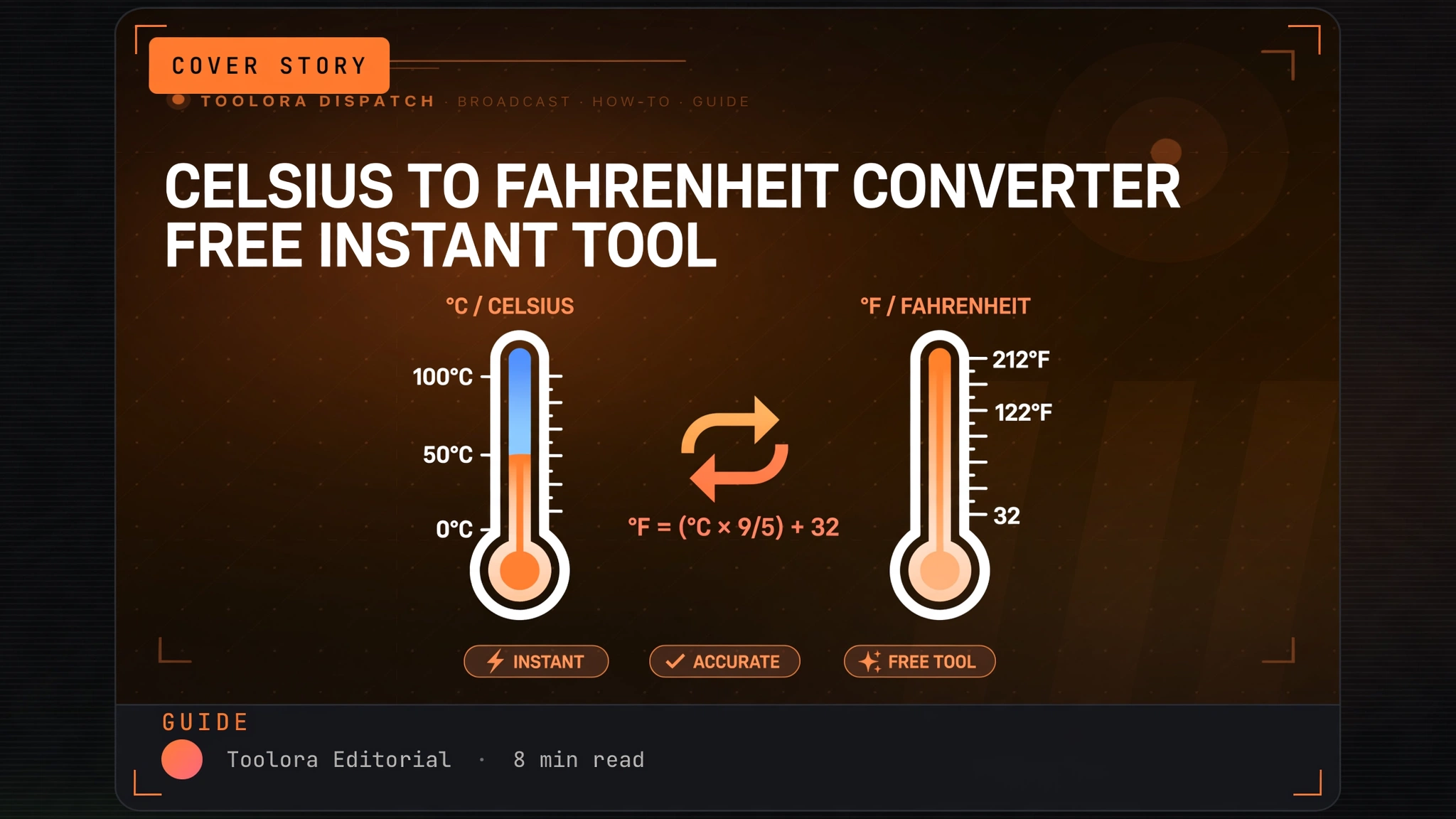
A Celsius to Fahrenheit converter instantly transforms any temperature by applying the formula °F = (°C × 9/5) + 32. For example, 100°C equals 212°F and 0°C equals 32°F. Use a free online converter tool to get accurate results in seconds without manual calculation.
Whether you're checking the weather forecast for an international trip, following a recipe from another country, monitoring a fever, or working on a science project, understanding how to switch between temperature scales is a practical skill. This complete guide walks you through everything you need to know about temperature conversion, from the mathematical formula to quick mental math tricks that experts use daily.
Celsius to Fahrenheit Converter: What It Is and Why You Need One
A Celsius to Fahrenheit converter is a digital tool that automatically applies the temperature conversion formula so you don't have to do the math yourself. Instead of pulling out a calculator, remembering multiplication tables, or making costly rounding errors, you simply input a value and receive an instant, accurate answer.
Here's why a free temperature converter tool is essential in today's globalized world:
- International travel: Weather apps in different regions display temperatures in different units. Knowing that 30°C feels like 86°F helps you pack appropriately.
- Cooking and baking: Recipes from the UK, Europe, or Australia use Celsius, while American recipes use Fahrenheit. A convert Celsius to Fahrenheit online tool prevents burnt cookies and undercooked meat.
- Medical monitoring: Body temperature readings, especially fever tracking, require precise conversion when using thermometers from different countries.
- Scientific work: Chemistry, physics, and biology often mix scales in academic and professional settings.
- HVAC and industrial use: Engineers, technicians, and manufacturers routinely convert between units for equipment specifications.
Our Celsius to Fahrenheit converter at Toolora eliminates guesswork and delivers instant results with zero installation, zero cost, and zero errors.
Understanding the Celsius to Fahrenheit Formula and How It Works
The Celsius to Fahrenheit formula is a simple linear equation:
°F = (°C × 9/5) + 32
Or equivalently: °F = (°C × 1.8) + 32
To reverse the process, the Fahrenheit to Celsius converter uses:
°C = (°F − 32) × 5/9
Why This Specific Formula?
The two scales were developed independently and use different reference points:
- Celsius scale: Created by Anders Celsius in 1742, based on water's freezing point (0°C) and boiling point (100°C) at sea level.
- Fahrenheit scale: Developed by Daniel Gabriel Fahrenheit in 1724, using a brine solution's freezing point (0°F) and human body temperature (originally 96°F, later refined).
The multiplier 9/5 (or 1.8) accounts for the fact that there are 180 Fahrenheit degrees between water's freezing and boiling points, but only 100 Celsius degrees. The +32 accounts for the offset between the two scales' zero points.
Breaking Down the Math Step by Step
Let's convert 25°C to Fahrenheit:
- Multiply 25 by 9/5: 25 × 1.8 = 45
- Add 32 to the result: 45 + 32 = 77
- Answer: 25°C = 77°F
This same logic powers every online temperature conversion calculator, including the tool at Toolora.
How to Convert Celsius to Fahrenheit in 3 Easy Steps
If you're wondering how to convert Celsius to Fahrenheit manually, follow this straightforward process:
Step 1: Take Your Celsius Value
Start with the number you want to convert. For example, let's use 20°C — a comfortable room temperature.
Step 2: Multiply by 1.8 (or 9/5)
20 × 1.8 = 36
This step scales the Celsius value to match the Fahrenheit scale's larger degree increments.
Step 3: Add 32
36 + 32 = 68°F
That's it! 20°C = 68°F.
For an even faster experience, skip the manual math and use the Toolora Celsius to Fahrenheit converter — just type the number and get an instant answer.
Common Temperature Reference Points Every Person Should Know
Memorizing a handful of key temperature equivalents will help you estimate quickly without a calculator. Here's a helpful comparison table:
| Celsius (°C) | Fahrenheit (°F) | Real-World Context |
|---|---|---|
| -40°C | -40°F | The only point where both scales meet |
| -18°C | 0°F | Standard freezer temperature |
| 0°C | 32°F | Water freezes |
| 10°C | 50°F | Cool autumn day |
| 20°C | 68°F | Comfortable room temperature |
| 25°C | 77°F | Warm spring day |
| 30°C | 86°F | Hot summer day |
| 37°C | 98.6°F | Normal human body temperature |
| 40°C | 104°F | High fever / very hot weather |
| 100°C | 212°F | Water boils at sea level |
| 180°C | 356°F | Common baking temperature |
| 200°C | 392°F | Hot oven roasting temperature |
Everyday Uses for These Reference Points
- Weather awareness: If a forecast says 35°C, you now know it's a scorching 95°F.
- Cooking: A recipe calling for 200°C oven heat translates to about 400°F.
- Health: A temperature of 38°C indicates a fever (100.4°F).
- Travel packing: 15°C weather (59°F) means a light jacket, not a heavy coat.
Tips and Best Practices for Accurate Temperature Conversion
To get the most out of any temperature conversion calculator, keep these expert tips in mind:
Watch the sign: Negative Celsius temperatures still follow the formula, but be careful with your math. For example, -10°C = (-10 × 1.8) + 32 = 14°F.
Round appropriately: For casual conversation, rounding to the nearest whole number is fine. For scientific or medical use, keep at least one decimal place.
Understand context: Body temperature conversions require precision. A one-degree difference in Fahrenheit can indicate a serious fever.
Bookmark a trusted tool: Save the Toolora temperature converter for one-click access whenever you need it.
Learn quick estimation tricks: Double the Celsius value and add 30 for a rough Fahrenheit estimate (accurate within a few degrees).
Cross-check important values: When cooking or handling medical equipment, verify conversions using a free temperature converter tool rather than relying on memory.
Common Mistakes to Avoid
- Forgetting to add 32: This is the most frequent error. Simply multiplying by 1.8 gives you a completely wrong answer.
- Using 5/9 instead of 9/5: The multiplication factor is 9/5 when converting from Celsius to Fahrenheit, not the other way around.
- Ignoring the negative sign: When working with sub-zero temperatures, keep negative numbers negative during multiplication.
- Confusing formulas: Some people mistakenly subtract 32 first when converting Celsius to Fahrenheit. Always multiply first, then add.
Frequently Asked Questions
What is the easiest way to convert Celsius to Fahrenheit?
The easiest way is to use an online Celsius to Fahrenheit converter like the free tool at Toolora. Simply enter your Celsius value, and the tool instantly displays the Fahrenheit equivalent using the standard formula °F = (°C × 9/5) + 32. This method eliminates human calculation errors and works on any device — smartphone, tablet, or desktop. If you prefer manual math, remember the three-step process: multiply by 1.8, then add 32. For rough estimates, you can also double the Celsius value and add 30, which gives an approximate answer within 2–3 degrees.
What is 37 degrees Celsius in Fahrenheit?
37°C equals 98.6°F, which is considered normal human body temperature. Here's the calculation: (37 × 1.8) + 32 = 66.6 + 32 = 98.6°F. This value is particularly important in medical contexts. Anything above 38°C (100.4°F) is typically classified as a fever, while temperatures below 35°C (95°F) may indicate hypothermia. Digital thermometers usually let you switch between Celsius and Fahrenheit, but if yours doesn't, the Toolora converter provides instant, reliable conversions.
Why do the US and other countries use different temperature scales?
The United States, along with the Bahamas, Belize, the Cayman Islands, and a few other territories, primarily uses the Fahrenheit scale due to historical adoption and infrastructure inertia. The scale was invented earlier (1724) and became standardized in American weather reporting, cooking, and industry long before global metrication efforts. Most of the world adopted the Celsius scale during the 19th and 20th centuries because it aligns naturally with the metric system, making scientific and international communication easier. Switching an entire nation's measurement system involves massive costs for updating textbooks, appliances, signage, and public awareness — which is why the US has maintained Fahrenheit despite official metric endorsements.
Is there a quick mental math trick for Celsius to Fahrenheit conversion?
Yes! The most popular trick is: double the Celsius value and add 30. For example:
- 20°C → (20 × 2) + 30 = 70°F (actual: 68°F)
- 30°C → (30 × 2) + 30 = 90°F (actual: 86°F)
- 10°C → (10 × 2) + 30 = 50°F (actual: 50°F)
This shortcut is accurate within 2–4 degrees for most everyday temperatures, making it perfect for quick weather estimates. For precise conversions — especially in cooking, science, or medicine — always use a proper temperature conversion calculator to avoid mistakes that could affect your results.
Get Instant, Accurate Results with Toolora's Free Converter
Manual calculations are useful for learning, but when accuracy and speed matter, nothing beats a dedicated conversion tool. The Toolora Celsius to Fahrenheit converter delivers instant results, works flawlessly on any device, requires no signup, and is 100% free forever.
Whether you're a student tackling homework, a home cook adapting an international recipe, a traveler navigating foreign weather forecasts, or a professional handling technical specifications — our converter is built to simplify your life.
👉 Try the free Celsius to Fahrenheit Converter at Toolora now and get accurate temperature conversions in a single click. Bookmark it, share it with friends, and never struggle with temperature math again!