Miles to Km Converter for Running, Driving & Cycling
Whether you're training for your first half-marathon, mapping out a European road trip, or comparing cycling routes with friends abroad, converting distances between miles and kilometers is a task you'll face often. A reliable miles to km converter removes the guesswork and delivers instant, accurate results every time.
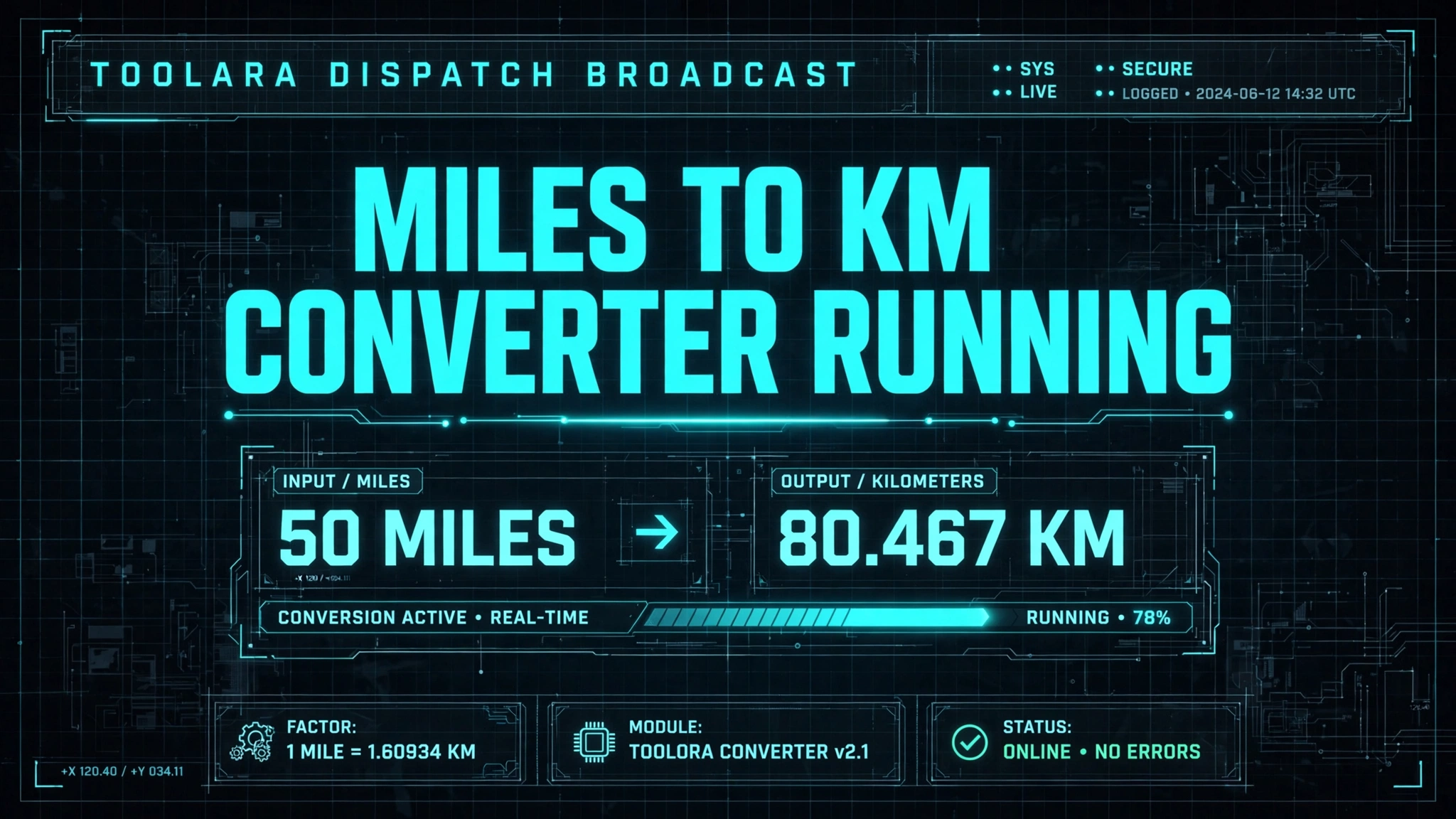
A miles to km converter instantly transforms any distance in miles into kilometers using the conversion factor of 1 mile = 1.60934 km. Whether you're tracking a 5K run, planning a road trip, or comparing cycling routes, an online miles to km converter saves time and eliminates manual math errors.
Miles to Km Converter: The Fastest Way to Switch Between Distance Units
The miles to km converter is one of the most-used unit conversion tools online — and for good reason. Distance is a universal measurement, but the world is split between two dominant systems: the imperial system (miles) used primarily in the United States, the United Kingdom, and a handful of other countries, and the metric system (kilometers) used almost everywhere else.
Here's why a free miles to km calculator matters:
- Speed: Instantly converts any distance in less than a second
- Accuracy: Uses the precise conversion factor of 1.60934 rather than rounded approximations
- Convenience: Works on phones, tablets, and desktops without downloads
- Versatility: Handles running distances, driving routes, cycling loops, hiking trails, and more
- Error-free: Eliminates the risk of manual math mistakes when planning trips or tracking workouts
The core math is simple: kilometers = miles × 1.60934. To reverse it, divide kilometers by 1.60934 to get miles. But when you're staring at a race registration form, a GPS device, or a travel itinerary, you don't want to pull out a calculator — you want an answer immediately. That's exactly what an online miles to km converter delivers.
If you frequently work with distances, you can also pair the converter with related Toolora utilities like the km to miles converter for reverse calculations, or the unit converter for broader measurement needs.
Why Miles and Kilometers Matter in Running, Driving, and Cycling
Understanding both units isn't just a math exercise — it's a practical skill that impacts your daily life. Here's how the two units show up in three of the most common contexts:
Running and Endurance Sports
Race distances are internationally standardized in kilometers: the 5K, 10K, half-marathon (21.0975 km), and marathon (42.195 km). Yet in the U.S., training plans, treadmill displays, and pace charts often use miles. A runner training for a 10K needs to know that it equals 6.21 miles, so they can gauge their weekly mileage properly.
Driving and Road Trips
If you're driving in Europe, Canada, Australia, or most of Asia, road signs and speedometers display kilometers. An American driver renting a car in France sees "Paris — 300 km" and instinctively wants to know that means about 186 miles. Fuel efficiency, toll distances, and estimated arrival times all shift with the unit.
Cycling and Bikepacking
Serious cyclists live in a hybrid world. Strava, Garmin, and Wahoo devices let you toggle between units, but race and event descriptions often mix them. A "100-mile century ride" equals 160.9 km, while a "gran fondo" in Italy might be listed as 130 km (roughly 80.8 miles).
How to Convert Miles to Km for Running, Driving, and Cycling Distances
Let's break down the practical steps and reference tables you'll actually use.
The Core Formula
Kilometers = Miles × 1.60934
You can round to 1.609 for quick mental math, but a proper convert miles to kilometers online tool uses the full decimal for precision.
Common Running Distances Table
| Distance (Miles) | Distance (Kilometers) | Common Use |
|---|---|---|
| 1 mile | 1.61 km | Track workouts |
| 3.1 miles | 5 km | 5K race |
| 6.2 miles | 10 km | 10K race |
| 13.1 miles | 21.1 km | Half-marathon |
| 26.2 miles | 42.2 km | Full marathon |
| 31 miles | 50 km | Ultra 50K |
| 62.1 miles | 100 km | Ultra 100K |
Common Driving Distances
For driving distance miles to km conversions, here are quick references:
- 10 miles = 16.09 km (typical city commute)
- 50 miles = 80.47 km (short highway drive)
- 100 miles = 160.93 km (day trip)
- 250 miles = 402.34 km (long road trip segment)
- 500 miles = 804.67 km (cross-region drive)
- 1,000 miles = 1,609.34 km (multi-day road trip)
Popular Cycling Distances
For miles to kilometers cycling applications:
- Metric century: 100 km = 62.14 miles
- Imperial century: 100 miles = 160.93 km
- Double century: 200 miles = 321.87 km
- Everesting climb: 8,848 m elevation (unit varies by rider)
Step-by-Step: Using the Toolora Miles to Km Converter
- Visit the miles to km converter tool page
- Enter your distance in miles (whole numbers or decimals both work)
- Read the instant kilometer result displayed below the input
- Copy or share the result as needed
- Reverse the calculation using the built-in swap function if desired
The tool handles everything from 0.1 miles (161 meters) to thousands of miles, making it useful for both micro-workouts and continental travel planning.
Tips and Best Practices for Using a Miles to Km Converter Accurately
Even a simple conversion has nuances. Here are expert tips to get the most from any free miles to km calculator:
1. Use the full conversion factor for official purposes. If you're submitting race results, engineering specs, or legal documents, use 1.60934 — not a rounded shortcut. Small rounding errors compound over long distances.
2. Watch out for statute vs. nautical miles. The standard miles to km converter uses statute miles (the everyday U.S. mile). If you're working with aviation or maritime distances, you need nautical miles, where 1 nautical mile = 1.852 km.
3. Convert pace along with distance. Runners often need to convert min/mile pace to min/km pace. A 10:00/mile pace equals roughly 6:13/km. Use a dedicated pace calculator alongside the miles to km converter for full training conversions.
4. Double-check GPS device settings. Before a race, make sure your watch is set to the correct unit. Many runners have accidentally raced a 5K thinking their watch was showing kilometers when it was displaying miles — or vice versa.
5. Round appropriately for context. Casual conversations don't need six decimal places. "About 8 km" is usually more useful than "8.0467 km" when telling a friend how far you ran.
6. Bookmark the tool. If you convert distances weekly, bookmark the miles to km converter for one-click access. This is especially helpful for miles to km running distance calculations during training.
Who Benefits Most From a Miles to Km Converter?
- Runners and triathletes planning international races
- Cyclists riding events in mixed-unit regions
- Travelers and expats navigating foreign road systems
- Students solving physics or geography problems
- Delivery drivers and logistics staff working across borders
- Fitness app users whose data exports in a different unit than their planning tools
Frequently Asked Questions
How many kilometers are in a mile?
There are exactly 1.60934 kilometers in one mile. This is the internationally accepted conversion factor for the statute mile (the standard mile used in everyday distance measurement). For quick mental math, you can approximate this as 1.6 km per mile, but for precise calculations — such as race distances, engineering, or scientific work — always use the full value. To reverse the conversion, one kilometer equals approximately 0.62137 miles. This means a 5-mile run equals 8.05 km, and a 10-km race equals 6.21 miles.
How do I convert marathon miles to kilometers?
A full marathon is officially 26.2 miles, which converts to 42.195 kilometers (often written as 42.2 km). A half-marathon is 13.1 miles or 21.0975 km. To convert any marathon-related distance, multiply your mile figure by 1.60934. For training splits, remember that mile 20 (the famous "wall" in marathon running) hits at approximately 32.19 km. Ultra-marathon runners frequently see distances like 50K (31 miles), 100K (62.14 miles), and 100 miles (160.93 km) in race listings — knowing these conversions helps you accurately plan pacing and nutrition strategies.
Why do some countries use miles while others use kilometers?
The split is rooted in history and policy. Kilometers are part of the metric system, formally introduced in France in 1795 and adopted globally through the International System of Units (SI). Most countries switched to metric in the 19th and 20th centuries for scientific consistency and trade. Miles originated from the Roman "mille passus" (1,000 paces) and were preserved in imperial-system countries — most notably the United States, United Kingdom, Liberia, and Myanmar. The UK uses miles for road distances but kilometers in science and athletics, creating a hybrid system that makes tools like a miles to km converter especially valuable for British users.
Can I use a miles to km converter for cycling speed as well as distance?
Yes, but with a slight adjustment. A standard miles to km converter handles distance, but speed conversions use the same factor: mph × 1.60934 = km/h. So 20 mph equals 32.19 km/h, and 25 mph equals 40.23 km/h. Many cycling computers let you toggle both distance and speed units simultaneously, but if yours doesn't, you can enter your mph value into a miles-based converter to get the equivalent km/h. For cadence, wattage, and elevation, no conversion is needed — those metrics are already unit-neutral or use meters (universally metric). For elevation conversions, use a dedicated feet to meters converter.
Start Converting Miles to Kilometers Instantly
Stop guessing, stop calculating by hand, and stop second-guessing your race pace or road trip ETA. The Toolora Miles to Km Converter delivers instant, precise results for every distance you throw at it — from a quick treadmill mile to a cross-country cycling tour.
👉 Try the free Miles to Km Converter on Toolora now and get accurate distance conversions in one click. No sign-up, no ads interrupting your workflow, no math required — just fast, reliable results for runners, drivers, cyclists, and everyone in between.