Compound Interest Calculator — See How Money Grows
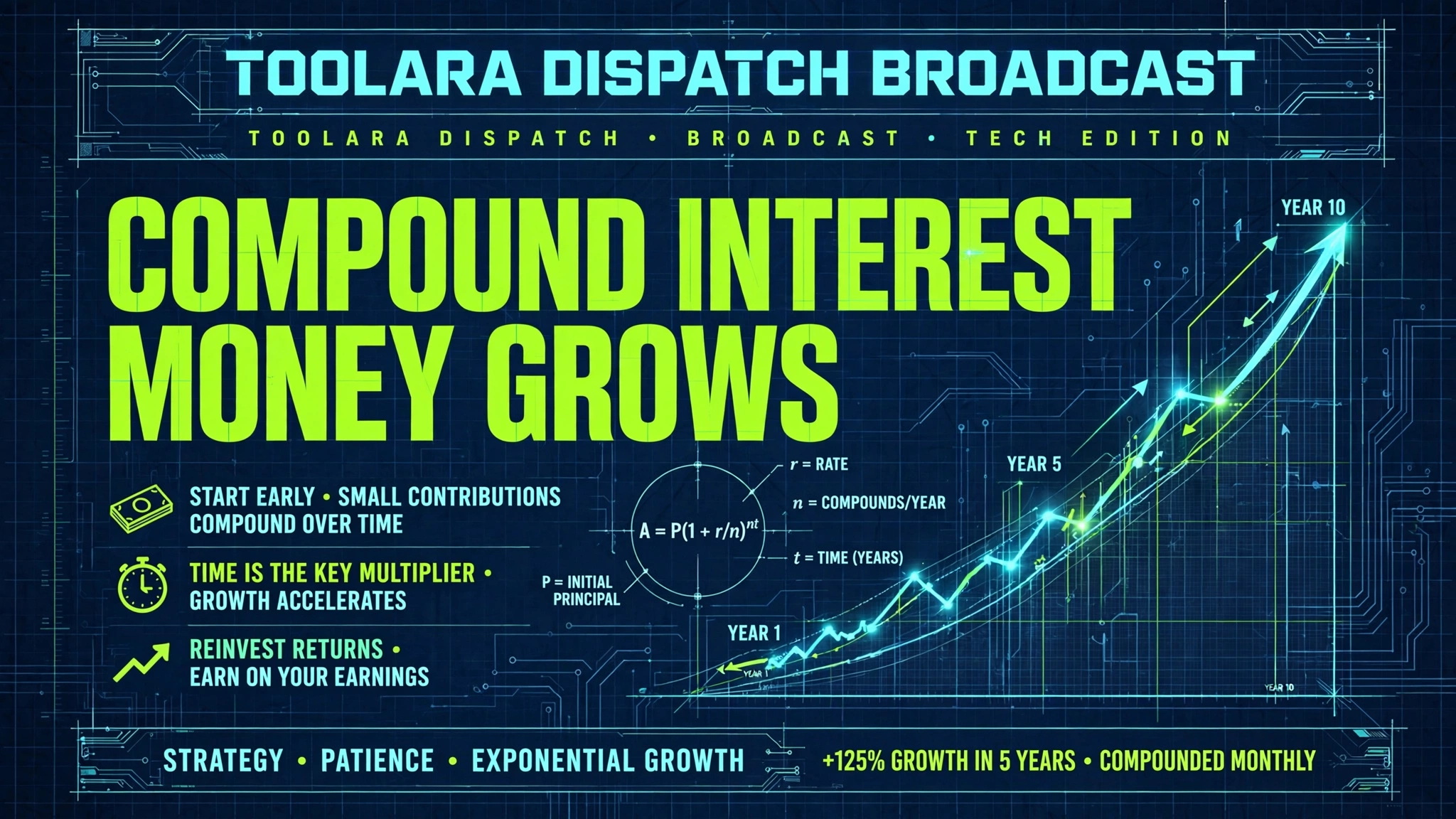
A compound interest calculator shows how your money grows by calculating interest on both your principal and previously earned interest over time. By entering your starting balance, interest rate, compounding frequency, and time period, you can instantly see your total returns. It's the fastest way to visualize the long-term power of compounding on savings or investments.
Whether you're saving for retirement, building an emergency fund, or planning your child's education, understanding how compound interest works can transform the way you think about money. In this guide, we'll break down everything you need to know — from the math behind compounding to how to use a compound interest calculator to project decades of growth in seconds.
Compound Interest Calculator: What It Is and Why It Matters for Your Money
A compound interest calculator is a financial planning tool that projects the future value of your investment or savings by applying compounding math over a chosen time horizon. Unlike simple interest, which only earns returns on your original deposit, compound interest snowballs — each interest payment gets added back to your balance and starts earning interest itself.
Here's why this matters:
- Time is your biggest asset: The earlier you start investing, the more compounding cycles your money experiences.
- Small contributions add up: Even $50 a month can grow into tens of thousands over decades.
- Visual clarity motivates action: Seeing the projection often pushes savers to invest more aggressively.
- Goal planning becomes easier: You can reverse-engineer how much to save monthly to hit a target.
Albert Einstein reportedly called compound interest "the eighth wonder of the world." Whether or not he actually said it, the sentiment holds — compounding is arguably the most powerful force in personal finance.
How Compound Interest Works — The Formula Behind the Growth
The compound interest formula explained in its classic form is:
A = P(1 + r/n)^(nt)
Where:
- A = the final amount (principal + interest)
- P = the initial principal (starting balance)
- r = the annual interest rate (as a decimal, e.g., 0.07 for 7%)
- n = the number of times interest compounds per year
- t = the number of years the money is invested
If you're adding regular contributions, the formula expands to include a series of future payments — that's where a compound interest calculator with contributions becomes essential, because doing it manually gets messy.
A Quick Example: How Compound Interest Works in Real Numbers
Let's say you invest $10,000 at a 7% annual return, compounded monthly, for 30 years:
- Principal: $10,000
- Interest earned: approximately $71,000
- Final balance: ~$81,000
That's a 700%+ return with zero additional contributions — just time and compounding doing the work.
How to Calculate Compound Interest Manually
If you want to know how to calculate compound interest manually, here's the process:
- Convert your interest rate to a decimal (7% → 0.07).
- Divide the rate by the number of compounding periods per year (0.07 / 12 = 0.00583).
- Add 1 to that number (1.00583).
- Raise it to the power of total compounding periods (12 × 30 = 360).
- Multiply the result by your principal.
For most people, using a best compound interest calculator online is far faster and eliminates rounding errors.
How to Use a Compound Interest Calculator Step by Step
Using the Toolora compound interest calculator takes less than a minute. Here's the step-by-step process:
- Enter your initial deposit — the amount you're starting with (e.g., $5,000).
- Add monthly or annual contributions — how much you plan to add regularly.
- Input the interest rate — the expected annual rate of return (e.g., 7%).
- Select compounding frequency — daily, monthly, quarterly, or annually.
- Choose your time horizon — how many years you'll let the money grow.
- Click calculate — instantly see your total balance, total contributions, and total interest earned.
Most quality calculators, including Toolora's, also show a year-by-year breakdown so you can visualize each year's growth. This helps you understand when the "snowball effect" really kicks in — typically around years 15–20 for long-term investments.
Daily vs. Monthly vs. Annual Compounding — Which Grows Your Money Faster?
One of the most common questions is daily vs monthly compound interest — does the frequency really matter? Yes, but perhaps less than you'd think. More frequent compounding does result in more interest, but the differences narrow at longer time horizons.
Here's a comparison of $10,000 invested at 7% for 20 years with different compounding frequencies:
| Compounding Frequency | Final Balance | Total Interest Earned |
|---|---|---|
| Annual (1x/year) | $38,697 | $28,697 |
| Quarterly (4x/year) | $40,064 | $30,064 |
| Monthly (12x/year) | $40,387 | $30,387 |
| Daily (365x/year) | $40,547 | $30,547 |
| Continuous | $40,552 | $30,552 |
Key takeaway: The jump from annual to monthly compounding is significant (~$1,700), but going from monthly to daily only nets you an extra ~$160 over 20 years. Focus on maximizing your rate and time rather than obsessing over compounding frequency.
When Frequency Matters Most
- High-interest accounts (10%+): Daily compounding provides a noticeable boost.
- Long time horizons (30+ years): Small differences compound into larger absolute gaps.
- Large principal amounts: Higher balances amplify the impact of frequency differences.
Tips and Best Practices to Maximize Compound Interest Returns
To get the most out of compound interest, follow these proven strategies:
- Start now, not later: A 25-year-old investing $200/month until 65 will typically outperform a 35-year-old investing $400/month until 65 — even though the older investor contributes more total dollars.
- Reinvest all dividends and interest: Never take payouts if your goal is long-term growth.
- Automate contributions: Set up automatic monthly transfers so you never miss a compounding cycle.
- Increase contributions annually: Even 1–2% yearly bumps add tens of thousands over decades.
- Choose tax-advantaged accounts: 401(k)s, IRAs, and Roth accounts let compounding work without tax drag.
- Minimize fees: A 1% fee difference can cost you 20–30% of your final balance over 40 years.
- Diversify wisely: Index funds historically deliver 7–10% real returns with lower risk than individual stocks.
- Use a calculator regularly: Rerun projections yearly with the Toolora tool to stay motivated.
Common Mistakes to Avoid
- Withdrawing early — even one withdrawal can set your compounding back years.
- Chasing high returns — a "safe" 7% consistently beats a volatile 15% average.
- Ignoring inflation — always account for 2–3% inflation when projecting real purchasing power.
- Underestimating time — most people focus on rate; time is often more powerful.
Frequently Asked Questions
What is the difference between simple interest and compound interest?
Simple interest is calculated only on your original principal, meaning your returns stay flat year after year. Compound interest, on the other hand, is calculated on your principal plus all previously earned interest, causing exponential growth over time. For example, $10,000 at 5% simple interest for 20 years grows to $20,000 — but with compound interest (annually), it becomes $26,533. Over longer periods or higher rates, the gap between simple and compound interest becomes dramatic, which is why compound interest is the foundation of nearly all modern investing.
How does a compound interest calculator handle monthly contributions?
A compound interest calculator with contributions treats each monthly deposit as a new mini-investment that begins compounding from the date it's added. Mathematically, this involves summing the future value of the principal plus the future value of an annuity (regular payments). The tool applies compounding to each contribution based on how long it will sit in the account before your target end date. This is why starting contributions early matters so much — your first year's contributions compound for the full duration, while your final year's contributions barely have time to grow.
What is a good interest rate to enter into a compound interest calculator?
For realistic projections, use rates aligned with your investment type:
- High-yield savings accounts: 4–5%
- Certificates of deposit (CDs): 3–5%
- Bond index funds: 4–6%
- Stock market index funds (long-term average): 7–10%
- Aggressive growth portfolios: 8–12% (with higher risk)
Most financial planners recommend using 7% as a conservative long-term stock market return after inflation. Avoid entering unrealistic rates like 15–20% — those aren't sustainable over decades and lead to disappointing real-world results.
How long does it take to double money using compound interest?
The famous Rule of 72 provides a quick estimate: divide 72 by your annual interest rate to get the approximate number of years it takes to double your money. For example:
- At 6%, money doubles in ~12 years
- At 8%, money doubles in ~9 years
- At 10%, money doubles in ~7.2 years
- At 12%, money doubles in ~6 years
This rule is a great mental shortcut, but a compound interest calculator will give you the precise answer including any monthly contributions.
Start Projecting Your Financial Future Today
Compound interest rewards those who understand it — and punishes those who don't. Whether you're saving your first $1,000 or optimizing a six-figure portfolio, seeing your numbers grow on screen is one of the most motivating financial exercises you can do.
Ready to see how your money can grow? Try the free Toolora Compound Interest Calculator now — enter your starting balance, contributions, and time horizon to instantly project your future wealth. No signup required, mobile-friendly, and completely free forever. Start planning your financial future in the next 60 seconds.