What is AI
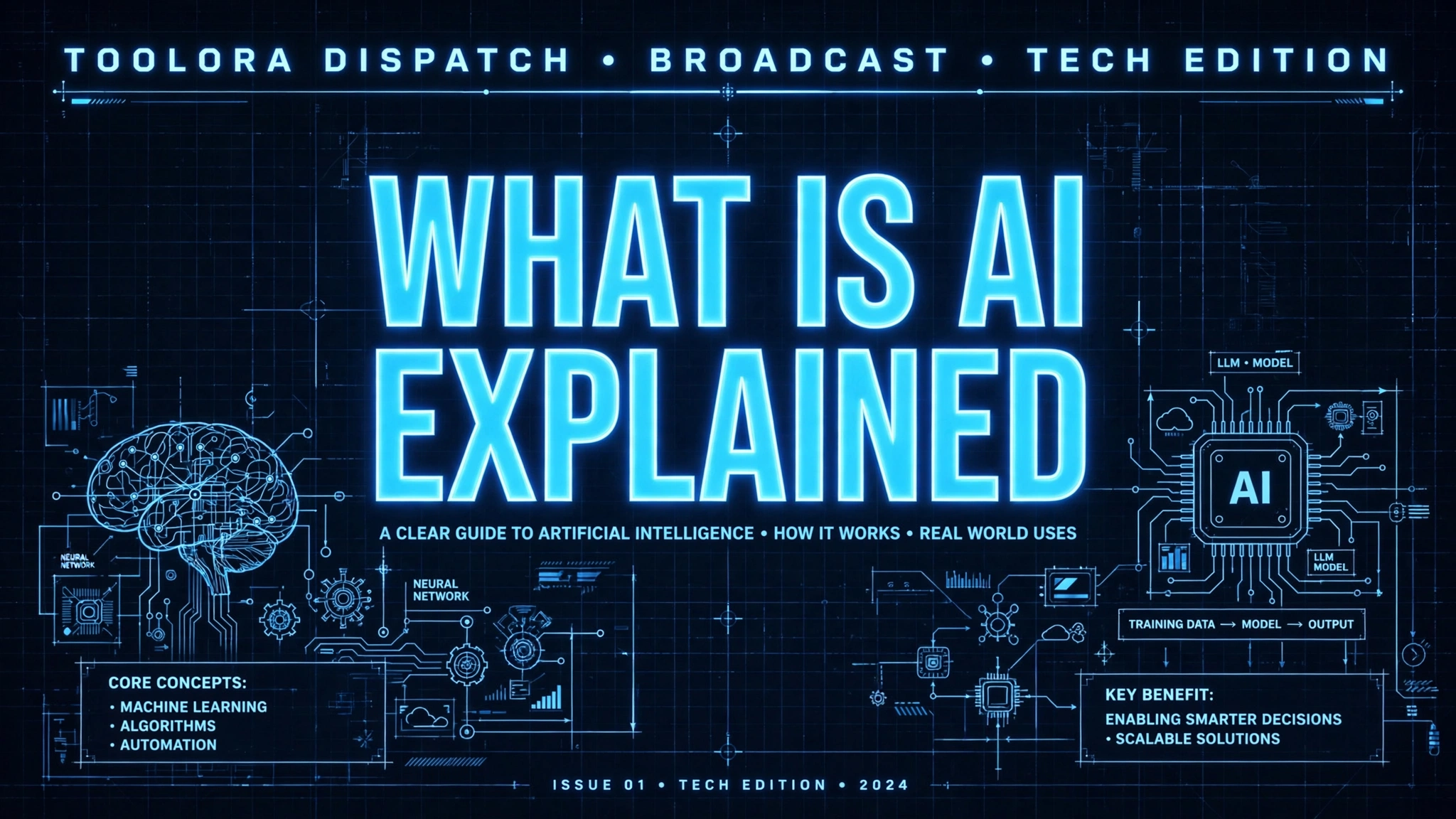

AI is software that learns from data to perform tasks that typically require human intelligence—like recognizing faces, understanding speech, or making decisions. That's the straightforward answer, but understanding how it works and why it matters will change how you see the technology surrounding you every day.
When you unlock your phone with your face or Netflix suggests your next binge-worthy show, artificial intelligence is quietly running in the background. By the end of this guide, you'll understand exactly what AI is, how it works, and how you can start using AI-powered tools yourself.
📈 Related: Bitcoin Price June 2026: Why BTC Is at $64K and What Happens Next — full market breakdown including ETF outflows, MicroStrategy's sell, and what to watch next.
Understanding AI: A Simple Definition
Artificial Intelligence combines two words that tell you exactly what it does: "artificial" (made by humans, not natural) and "intelligence" (the ability to learn, reason, and solve problems).
Think of AI like teaching a dog new tricks—except instead of treats, you use data, and instead of a dog, you have software. You show the AI thousands of examples, it learns the patterns, and eventually it can make predictions or decisions on its own.
The term "artificial intelligence" was coined in 1956 by computer scientist John McCarthy at a famous conference at Dartmouth College. McCarthy defined AI as "the science and engineering of making intelligent machines." Nearly 70 years later, that definition still holds up remarkably well.
Simple Definition Box:
AI is computer software designed to mimic human thinking—learning from experience, adapting to new information, and performing tasks that typically require human intelligence.
How Does AI Work?

Understanding AI doesn't require a computer science degree. At its core, AI follows a logical process that mirrors how humans learn—just at a massive scale.
Data as Fuel
Every AI system starts with data. Lots of it. An AI that recognizes cats has seen millions of cat photos. An AI that transcribes speech has listened to thousands of hours of human conversation.
Data is to AI what experience is to humans. The more quality examples an AI system processes, the better it becomes at its specific task. This is why companies like Google and Meta collect so much user data—it directly improves their AI systems.
Algorithms and Pattern Recognition
Algorithms are step-by-step instructions that tell the AI how to process data. These algorithms look for patterns—connections between inputs and outputs that repeat consistently.
For example, a spam filter algorithm learns that emails containing phrases like "you've won a million dollars" combined with suspicious sender addresses are usually spam. It finds this pattern across thousands of examples, then applies it to new emails.
Training and Learning Process
Training an AI is like studying for an exam:
- Feed the AI labeled examples (this is a cat, this is a dog)
- The AI makes predictions on new examples
- Check if predictions are correct
- Adjust the algorithm to improve accuracy
- Repeat millions of times
This cycle continues until the AI achieves acceptable accuracy. Some AI models train for weeks on specialized hardware costing millions of dollars.
Decision Making
Once trained, the AI applies what it learned to make decisions on new data it's never seen before. When you upload a photo to Google Photos and it automatically tags your friends' faces, that's a trained AI making decisions based on patterns learned during training.
The 4 Main Types of Artificial Intelligence
Not all AI is created equal. Researchers classify AI into four types based on capabilities—and we're still working on the last two.
Reactive Machines
The simplest form of AI—these systems can only react to current situations with no memory of past interactions.
IBM's Deep Blue, which defeated chess champion Garry Kasparov in 1997, is the classic example. It analyzed the current chess board position and calculated the best move, but couldn't remember previous games or learn from past matches.
Modern examples include:
- Basic spam filters
- Product recommendation engines
- Simple chatbots with scripted responses
Limited Memory AI
This is where most current AI lives. These systems can learn from historical data and past experiences to improve future decisions.
Limited Memory AI powers:
| Application | How It Uses Memory |
|---|---|
| Self-driving cars | Remembers road patterns, pedestrian behavior |
| Virtual assistants | Recalls your preferences and past requests |
| ChatGPT | Uses conversation context within a session |
| Fraud detection | Learns from past fraudulent transaction patterns |
Your smartphone's facial recognition improves over time because it has limited memory—it learns as your appearance subtly changes.
Theory of Mind AI
This type doesn't exist in production systems today, though research prototypes are being developed. Theory of Mind AI would understand emotions, beliefs, and thought processes—essentially understanding that other beings have their own mental states.
Imagine an AI assistant that recognizes you're stressed from your typing patterns and proactively suggests taking a break. We're making progress, but true Theory of Mind AI remains in research labs.
Self-Aware AI
The most advanced (and currently theoretical) AI type would have consciousness and self-awareness. This is the AI of science fiction—systems that understand their own existence.
No self-aware AI exists today, despite what headlines might suggest. Current AI systems, no matter how impressive, have no inner experience or self-understanding.
AI vs. Machine Learning vs. Deep Learning

These terms get thrown around interchangeably, but they're actually nested concepts—like Russian dolls.
Here's the relationship:
AI (broadest concept)
└── Machine Learning (subset of AI)
    └── Deep Learning (subset of ML)
Artificial Intelligence: The overall goal of creating machines that can perform intelligent tasks.
Machine Learning: A specific approach to achieving AI where systems learn from data without being explicitly programmed for every scenario.
Deep Learning: A specialized type of machine learning using neural networks with many layers (hence "deep") that excel at processing unstructured data like images and speech.
| Term | What It Means | Example |
|---|---|---|
| AI | Any computer system mimicking human intelligence | Chess-playing program |
| Machine Learning | AI that improves through experience | Email spam filter that gets smarter |
| Deep Learning | ML using layered neural networks | Face recognition in photos |
When someone says "AI," they usually mean machine learning. When they say "machine learning," they often mean deep learning. For everyday conversations, using them interchangeably won't cause problems—but now you know the precise differences.
Real-World AI Examples in Everyday Life
AI isn't some far-off technology—you're probably using it dozens of times daily without realizing it.
Virtual Assistants (Siri, Alexa, Google Assistant)
When you ask Siri "What's the weather today?", AI processes your voice, converts speech to text, interprets your intent, retrieves weather data, and generates a spoken response—all in under two seconds.
According to Statista, over 4.2 billion voice assistants are in use worldwide as of 2024.[^1]
Recommendation Systems (Netflix, Spotify)
Netflix reports that its recommendation AI significantly influences content discovery on the platform.[^2] It analyzes your viewing history, time of day, pause patterns, and similarity to other users to suggest what you'll probably enjoy next.
Spotify's Discover Weekly playlist—powered by AI—has become one of the platform's most popular features, driving substantial listening engagement since its launch.[^3]
Smart Home Devices
Your smart thermostat learns your schedule and temperature preferences. Robot vacuums map your home and optimize cleaning routes. Smart doorbells use facial recognition to identify visitors.
Social Media Algorithms
Every time you scroll Instagram or TikTok, AI decides what appears next. It weighs hundreds of factors: what you've liked, how long you've watched similar content, what time it is, and what your friends engage with.
Email Spam Filters
Gmail's AI blocks the vast majority of spam before it reaches your inbox. AI analyzes sender reputation, email content, link destinations, and sending patterns to make millisecond decisions about every incoming message.
Navigation Apps (Google Maps)
Google Maps AI predicts traffic conditions, suggests optimal routes, estimates arrival times, and reroutes you around accidents in real-time—all using machine learning models trained on billions of trips.
Common Applications of AI Technology
Beyond consumer apps, AI is transforming entire industries.
Medical Information Disclaimer: The following content about healthcare AI is for informational purposes only and does not constitute medical advice. AI medical applications should be used under professional healthcare supervision. Consult a qualified healthcare provider for medical decisions.
Healthcare:
- Studies have shown AI systems can detect certain cancers (such as breast and lung cancer) in medical scans with accuracy comparable to human radiologists in controlled settings[^4]
- Drug discovery AI reduces development timelines from years to months
- Chatbots handle initial patient symptom screening
Finance:
- Banks use AI to detect fraudulent transactions in real-time, significantly reducing fraud losses
- Algorithmic trading executes trades faster than human reaction time
- Credit scoring models assess loan risk more accurately
Retail:
- Dynamic pricing adjusts product costs based on demand and competition
- Inventory management AI predicts stock needs before shortages occur
- Visual search lets customers find products by uploading photos
Manufacturing:
- Predictive maintenance AI anticipates equipment failures before they happen
- Quality control systems inspect products at superhuman speeds
- Supply chain optimization reduces waste and delays
Education:
- Adaptive learning platforms adjust difficulty based on student performance
- AI tutors provide personalized feedback at scale
- Automated grading saves teachers hundreds of hours annually
Benefits of Artificial Intelligence
AI isn't just impressive technology—it delivers measurable advantages.
Efficiency and Automation: AI handles repetitive tasks without fatigue. A human might review 50 loan applications daily; AI can review thousands with consistent accuracy.
24/7 Availability: AI systems don't need sleep, breaks, or vacations. Customer service chatbots resolve issues at 3 AM just as effectively as 3 PM.
Reduced Human Error: Tired or distracted humans make mistakes. AI applies the same consistent logic to task #1 and task #10,000.
Data-Driven Insights: AI finds patterns in datasets too large for human analysis. Retailers use AI to identify purchasing trends across millions of transactions.
Accessibility Improvements: AI enables text-to-speech for visually impaired users, real-time translation for non-native speakers, and predictive text for those with motor difficulties.
Risks and Challenges of AI
Responsible AI adoption requires understanding legitimate concerns.
Job Displacement: McKinsey estimates AI could automate approximately 30% of work activities by 2030.[^5] While new jobs will emerge, the transition will affect millions of workers in specific industries.
Privacy and Surveillance: AI-powered facial recognition and data analysis enable unprecedented surveillance capabilities. Balancing security benefits against privacy rights remains contentious.
Algorithmic Bias: AI systems trained on biased data produce biased outcomes. Studies have found facial recognition systems performing worse on darker skin tones, and hiring AI penalizing candidates from certain backgrounds.
Security Vulnerabilities: AI systems can be fooled by "adversarial attacks"—carefully crafted inputs designed to cause misclassification. Researchers have demonstrated adversarial attacks against self-driving car AI, such as modified stop signs that cause misidentification.[^6]
Ethical Considerations: Who's responsible when autonomous AI makes harmful decisions? How do we ensure AI benefits everyone, not just wealthy nations and corporations?
The Future of AI: What's Next?
We're currently in the era of generative AI—systems like ChatGPT that create new content rather than just analyzing existing data.
Note: This section contains predictions about future technology which may not materialize as described.
Current Trends:
- Large Language Models (LLMs) becoming more capable and accessible
- AI image generation reaching photorealistic quality
- Code generation AI assisting (not replacing) programmers
- Multimodal AI combining text, image, and audio understanding
Emerging Technologies:
- AI agents that can complete multi-step tasks autonomously
- On-device AI running locally without internet connection
- AI systems that explain their reasoning ("explainable AI")
Realistic Timeline:
- 2024-2026: AI assistants become standard workplace tools
- 2027-2030: Industry analysts predict autonomous vehicles may reach broader adoption in controlled environments
- 2030+: AI may augment most knowledge work (complementing rather than replacing humans)
The key insight: AI will increasingly become invisible—embedded in every service and product we use, much like electricity today.
Try AI-Powered Tools on Toolora
Understanding AI concepts is useful, but experiencing AI firsthand is transformative. Toolora offers free AI-powered tools you can use right now without any signup or technical knowledge.
Explore what's available:
- AI text generation tools for writing assistance
- AI image enhancement tools for photo editing
- And many more free utilities in our growing collection
The best way to understand AI? Start using it.
Frequently Asked Questions About AI
What does AI stand for?
AI stands for Artificial Intelligence. "Artificial" means human-made (not natural), and "intelligence" refers to the ability to learn, reason, and solve problems. Together, AI describes computer systems designed to perform tasks that typically require human intelligence.
Is AI dangerous?
AI itself isn't inherently dangerous—it's a tool. Like any powerful technology (nuclear energy, genetic engineering), the risks depend on how humans choose to use it. Current concerns include job displacement, privacy erosion, and algorithmic bias rather than science-fiction scenarios of robot uprisings. Responsible development and regulation can mitigate most risks.
Can AI replace humans?
AI can replace humans at specific tasks but not replace humans entirely. AI excels at narrow, repetitive, data-intensive work. However, AI cannot replicate human creativity, emotional intelligence, ethical judgment, or genuine understanding. The more likely future: AI augments human capabilities rather than fully replacing human workers.
What programming languages are used for AI?
Python dominates AI development due to its extensive libraries (TensorFlow, PyTorch, scikit-learn) and readable syntax. Other languages used include:
- R (statistical analysis)
- Java (enterprise AI applications)
- C++ (performance-critical systems)
- Julia (scientific computing)
Beginners should start with Python—it's the industry standard with the best learning resources.
How can I learn AI?
Start with these steps:
- Learn Python basics (free via Codecademy or freeCodeCamp)
- Study fundamental math (linear algebra, statistics)
- Take an intro course (Andrew Ng's Machine Learning on Coursera)
- Build simple projects (spam classifier, image recognizer)
- Specialize in an area that interests you (NLP, computer vision, etc.)
Expect 6-12 months of dedicated learning before building useful AI applications. Many resources are completely free.
References
[^1]: Statista. "Number of voice assistants in use worldwide." 2024. https://www.statista.com/statistics/973815/worldwide-digital-voice-assistant-in-use/
[^2]: Netflix Technology Blog. "How Netflix's Recommendations System Works." https://research.netflix.com/research-area/recommendations
[^3]: Spotify Engineering Blog. "Discover Weekly and Personalized Playlists." https://engineering.atspotify.com/
[^4]: McKinney, S.M., et al. "International evaluation of an AI system for breast cancer screening." Nature, 2020. https://www.nature.com/articles/s41586-019-1799-6
[^5]: McKinsey Global Institute. "Jobs lost, jobs gained: Workforce transitions in a time of automation." 2017. https://www.mckinsey.com/featured-insights/future-of-work/jobs-lost-jobs-gained-what-the-future-of-work-will-mean-for-jobs-skills-and-wages
[^6]: Eykholt, K., et al. "Robust Physical-World Attacks on Deep Learning Visual Classification." CVPR, 2018. https://arxiv.org/abs/1707.08945
Last Updated: January 2025
Last Fact-Checked: January 2025