Gold Price Calculator: How to Find Your Gold's Value
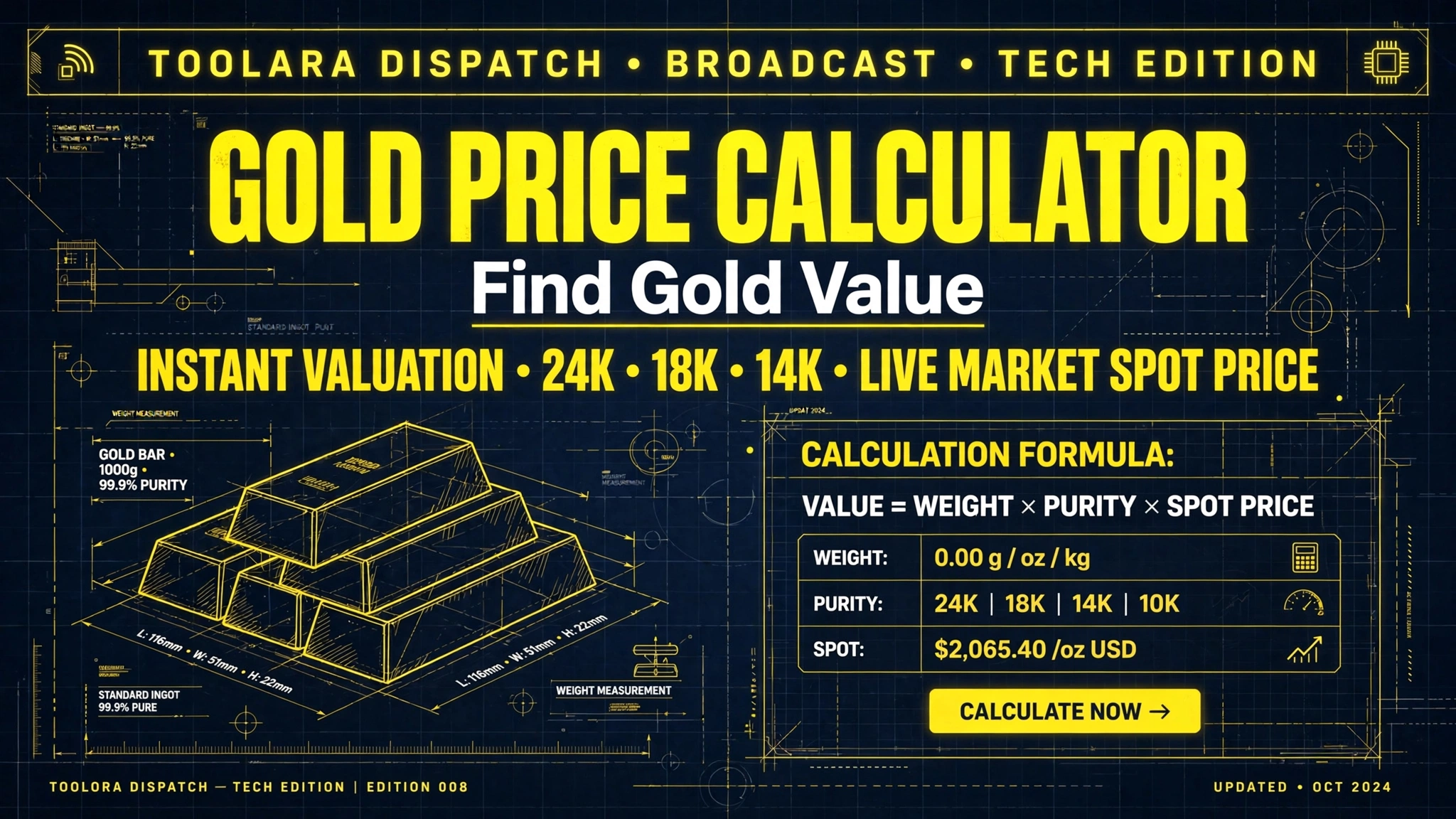
Whether you're selling a broken chain, appraising an inherited ring, or investing in bullion, knowing exactly what your gold is worth is the difference between a fair deal and a costly mistake. A reliable gold price calculator removes the guesswork by combining live spot prices with karat purity to deliver an accurate valuation in seconds.
A gold price calculator helps you determine the current monetary value of your gold by multiplying its weight in grams or troy ounces by the live spot price per unit, then adjusting for karat purity. To find your gold's value, simply enter the weight, select the karat (10K, 14K, 18K, 24K), and the calculator applies the correct purity percentage automatically. This gives you an accurate melt value whether you're buying, selling, or appraising gold jewelry or bullion.
Gold Price Calculator: What It Is and Why It Matters for Buyers and Sellers
A gold price calculator is an online tool that instantly converts the weight and purity of your gold into its current market value using real-time or up-to-date spot pricing. Instead of manually researching gold prices, converting units, and applying karat percentages, the calculator handles all the math with a few simple inputs.
This matters more than most people realize. Gold prices fluctuate daily — sometimes swinging by $30 or more per troy ounce within a single trading session. Without a calculator that reflects current market conditions, you could easily leave hundreds of dollars on the table when selling scrap jewelry or overpay when buying bullion.
Who benefits most from using a gold price calculator?
- Scrap gold sellers who want to verify pawnshop and cash-for-gold offers
- Jewelry buyers comparing retail markups to true melt value
- Investors valuing coins, bars, and bullion holdings
- Estate executors appraising inherited pieces
- Pawnbrokers and jewelers offering fair, transparent quotes
- Refiners and dealers calculating trade-in credits
The biggest advantage is transparency. When both parties in a transaction reference the same objective calculation, negotiations become fairer and faster. Tools like the gold price calculator on Toolora put professional-grade valuation in the hands of everyday users at no cost.
How Gold Purity (Karats) Affects the Value Your Calculator Returns
The karat rating of your gold is one of the two most important variables in any calculation — the other being weight. Karat measures the proportion of pure gold in an alloy, with 24K being 100% pure gold. Because pure gold is soft, most jewelry contains other metals (copper, silver, nickel, zinc) for strength and color, which reduces its gold content and therefore its melt value.
Here's how the standard karat ratings translate into purity percentages that a gold calculator by weight uses automatically:
| Karat | Purity % | Gold Content | Common Use |
|---|---|---|---|
| 24K | 99.9% | Pure gold | Bullion, coins, investment bars |
| 22K | 91.6% | Very high | Fine jewelry, Asian markets |
| 18K | 75.0% | High | Premium jewelry, luxury watches |
| 14K | 58.3% | Medium | Most US jewelry, wedding bands |
| 10K | 41.7% | Low | Budget jewelry, class rings |
| 9K | 37.5% | Low | European budget jewelry |
How the math actually works: If gold's spot price is $75 per gram and you have 10 grams of 14K gold, the calculator multiplies 10 × $75 × 0.583 = $437.25 melt value. That same 10 grams in 18K would be worth $562.50, and in 24K it would be worth the full $750.
This is why a 14k gold price calculator and an 18k version will return very different numbers for identical weights. Always check the hallmark stamp on your jewelry before running the calculation — common markings include "585" (14K), "750" (18K), and "999" (24K).
How to Use a Gold Price Calculator Step by Step
Getting an accurate valuation takes less than a minute if you follow the right process. Here's exactly how to calculate gold value using an online tool:
- Weigh your gold accurately. Use a digital jewelry scale that measures to at least 0.1 grams. Weigh each karat purity separately — don't mix 14K and 18K pieces on the scale together.
- Identify the karat. Look for a hallmark stamp inside rings, on chain clasps, or on the back of pendants. If there's no stamp, a jeweler can test it with acid or an XRF machine.
- Remove non-gold components. Subtract the weight of gemstones, clasps made of other metals, and any glued backing. This step alone can prevent overvaluing a piece by 10–20%.
- Open the calculator. Head to a reliable gold price per gram calculator like the one at Toolora.
- Enter the weight in grams (or ounces, depending on the tool).
- Select the karat from the dropdown menu.
- Review the live spot price displayed by the calculator and confirm it matches a trusted market source.
- Read the calculated value — this is your gold's raw melt value before any dealer premiums or discounts.
Pro tip: Run the calculation twice using slightly different spot prices (say, $5 higher and $5 lower per gram) to see how sensitive your item's value is to market movement. This gives you a realistic negotiating range.
Gold Price Calculator Tips: Getting the Most Accurate Value for Your Gold
Even the best scrap gold calculator is only as accurate as the inputs you give it. Here are the professional habits that separate a rough estimate from a reliable number:
- Use a certified scale. Kitchen scales and postal scales are often off by 0.5g or more, which adds up quickly across multiple items. Jewelry scales calibrated in grams and grains are ideal.
- Weigh in grams, not pennyweights. Some US dealers quote in pennyweights (dwt) to make offers look higher than they are. 1 pennyweight = 1.555 grams. Always convert to grams for apples-to-apples comparisons.
- Understand the difference between melt value and payout. A gold melt value calculator shows the raw metal value. Dealers typically pay 70–90% of melt value for scrap, with the remainder covering refining costs and profit margin. Pawnshops often pay much less — sometimes 40–60%.
- Sort by karat before weighing. A pile of mixed jewelry can't be accurately valued as a single lump. Group 10K, 14K, and 18K items separately.
- Account for gold-filled and gold-plated items. These contain only trace amounts of gold and are essentially worthless for scrap sale. Look for stamps like "GF," "GP," "HGE," or "1/20 12K GF."
- Track prices over time. Gold moves in cycles. If you're not in a rush to sell, using a calculator weekly can help you time the market for a better return.
- Get multiple quotes. Once you know the melt value, request quotes from at least three buyers — a local jeweler, an online refiner, and a pawnshop. The spread will surprise you.
For quick unit conversions during your research, Toolora also offers a unit converter and a percentage calculator that pair perfectly with gold valuation workflows.
Frequently Asked Questions
What is the formula used in a gold price calculator?
The core formula is: Gold Value = Weight × Spot Price × Purity Percentage. For example, 20 grams of 18K gold at a spot price of $75/gram would calculate as 20 × 75 × 0.75 = $1,125 melt value. If the tool works in troy ounces, it uses the same formula but with the ounce-based spot price (1 troy ounce = 31.1035 grams). A quality gold calculator by weight handles all unit conversions automatically, so you only need to input the weight and karat.
How do I find the current gold spot price for my calculation?
Most reliable calculators pull live spot prices automatically from major exchanges like COMEX or the London Bullion Market. If you want to verify the number, check trusted sources such as Kitco, the World Gold Council, or major financial news sites like Bloomberg and Reuters. The spot price is quoted per troy ounce in USD by convention, but it's also commonly displayed per gram. Remember that spot price represents wholesale trading value — retail buyers and dealers work within a spread around this number.
Can a gold price calculator tell me what a dealer will pay for my scrap gold?
Not exactly — but it gives you the essential benchmark to negotiate from. A calculator returns the melt value, which is the theoretical value of the pure gold content if refined. Dealers deduct refining costs, assay fees, and their profit margin, typically paying 70–90% of melt value for standard karat gold. Online refiners like Kitco and Cash for Gold USA tend to offer the highest percentages, while walk-in pawnshops offer the lowest. Always calculate melt value first, then evaluate offers as a percentage of that number.
Is 14K or 18K gold worth more when I run it through a gold price calculator?
Per gram, 18K gold is worth significantly more than 14K gold — roughly 28.6% more, since 18K contains 75% pure gold versus 14K's 58.3%. However, total value depends on weight. A heavy 14K chain can easily be worth more than a small 18K ring. When comparing pieces, always calculate on a per-gram basis first, then multiply by total weight. This is why running each piece separately through a 14k gold price calculator — rather than eyeballing based on size — reveals the true value distribution across your collection.
Ready to Find Out What Your Gold Is Worth?
Stop guessing what your gold jewelry, coins, or scrap pieces are actually worth. Whether you're preparing to sell, negotiating with a dealer, or simply curious about the value sitting in your jewelry box, our free gold price calculator delivers accurate melt values in seconds — no signup, no email required.
Try the free Toolora Gold Price Calculator now → and get an instant, transparent valuation based on live market prices and your gold's exact karat purity. Make your next gold transaction with confidence, backed by real numbers.