USD to EUR: How Currency Exchange Rates Work
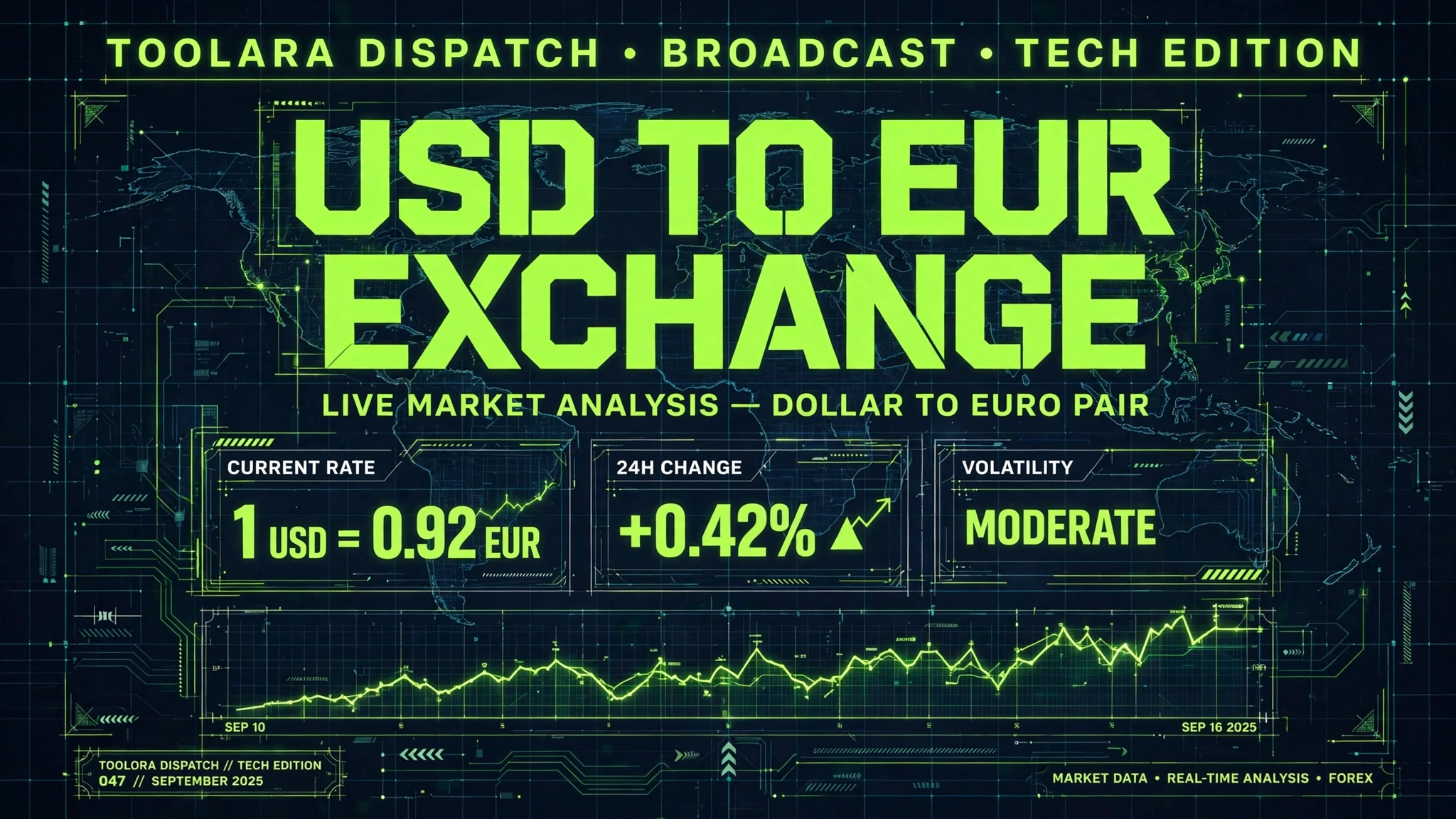

The USD to EUR exchange rate tells you how many euros you get for one US dollar at any given moment. The rate fluctuates continuously based on global market forces, so any specific figure can become outdated quickly — always check a live source before transacting.
If you're traveling to Europe, paying an international invoice, shopping on a European website, or just curious about how money moves across borders, understanding the dollar to euro conversion is essential. This guide breaks down exactly how the rate is set, why it changes, and how to convert accurately without losing money to hidden fees.
Quick tool: Check today's USD to EUR rate instantly with our free Currency Converter. It updates with live market data so you always see the real rate.
📈 Related: Bitcoin Price June 2026: Why BTC Is at $64K and What Happens Next — full market breakdown including ETF outflows, MicroStrategy's sell, and what to watch next.
What Is the USD to EUR Exchange Rate?
The USD/EUR exchange rate is the price of the US dollar expressed in euros. In simple terms, it answers the question: "How many euros does one dollar buy right now?"
You'll usually see it quoted in two ways:
- EUR/USD = 1.0850 → 1 euro = 1.0850 US dollars
- USD/EUR = 0.9217 → 1 US dollar = 0.9217 euros
The euro is considered the base currency in the more common EUR/USD quote because the European convention is to lead with the euro. Most financial news sites, Bloomberg terminals, and forex platforms display it this way. To flip it into a USD-first view, simply divide 1 by the EUR/USD rate.
The EUR/USD pair is one of the most actively traded currency pairs in the world, consistently accounting for a significant share of daily forex volume. According to the Bank for International Settlements, total daily forex turnover across all currency pairs exceeds $7 trillion.
How Currency Exchange Rates Are Determined
Currency exchange rates are set by the foreign exchange market (forex) — a decentralized global marketplace where banks, governments, corporations, and traders buy and sell currencies 24 hours a day, five days a week.
There are two primary types of exchange rate systems:
1. Floating Exchange Rates (USD and EUR)
Both the dollar and euro use a floating system, meaning their values are determined by supply and demand. No central authority sets a fixed price. If more people want dollars, the dollar strengthens. If demand for euros rises, the euro appreciates.
2. Fixed (Pegged) Exchange Rates
Some countries peg their currency to another (often the USD). The Saudi riyal and Hong Kong dollar are examples. The USD/EUR rate, however, is purely market-driven.
Key Forces Behind Exchange Rates
- Interest rates set by the Federal Reserve (US) and European Central Bank (ECB)
- Inflation rates in each economy
- Economic data (GDP growth, unemployment, manufacturing indexes)
- Political stability and geopolitical events
- Trade balances between regions
- Market speculation by hedge funds and institutional traders
When the Fed raises interest rates, the dollar often strengthens because investors may earn more on dollar-denominated assets. The same logic applies in reverse for the ECB and the euro, though market reactions vary and are never guaranteed.
Why the USD/EUR Rate Changes Daily
You may have noticed that the forex exchange rate today is different from yesterday — sometimes by fractions of a cent, sometimes by 1–2%. Here's why:
- Continuous trading. Forex markets are open 24/5, so prices update constantly as Asia, Europe, and the Americas overlap.
- News-driven volatility. Inflation reports, jobs data, and central bank announcements can move the rate within seconds.
- Capital flows. Large institutions moving billions between US Treasuries and European bonds shift demand instantly.
- Risk sentiment. During global uncertainty, the dollar often acts as a "safe haven," pushing USD higher relative to the euro.
- Energy and commodity prices. Europe imports significant energy; rising oil prices can put pressure on the euro.
This is why the rate at your bank on Tuesday morning may differ from the rate Tuesday afternoon — and why locking in a conversion at the right moment can save real money on large transfers.
How to Read and Calculate a USD to EUR Conversion
Let's walk through a simple USD EUR calculator example.
Scenario: You want to convert $500 USD to euros. The current rate is EUR/USD = 1.0850.
Step-by-step calculation:
- Take your USD amount: $500
- Divide by the EUR/USD rate: 500 ÷ 1.0850
- Result: €460.83
If instead the rate is given as USD/EUR = 0.9217:
- Multiply your USD amount by the rate: 500 × 0.9217
- Result: €460.85 (small rounding difference)
What about fees and the spread?
Banks and exchange providers rarely give you the mid-market rate (the "true" rate you see on Google or Reuters). They add a markup called the spread, which varies by provider and transaction size. That means on a $500 conversion, the euros you actually receive may be noticeably less than the mid-market calculation suggests.
Always compare:
- Mid-market rate (the real rate)
- Provider's offered rate (what you actually get)
- Flat fees (which vary widely by provider)
For accurate, real-time mid-market conversions, use the Currency Converter on Toolora before agreeing to any exchange.
Where to Exchange USD to EUR (and What to Avoid)
Not all exchange options are equal. Here's a general guide from better to worse value — though rates and fees vary, so always compare before transacting:
✅ Generally Better Options
- Multi-currency accounts (such as services from providers like Wise or Revolut) — often offer rates close to mid-market with transparent fees; check current terms before using
- Local European ATMs with a no-foreign-fee debit card — usually a modest markup above mid-market
- Major brokerages for large amounts — may offer more competitive rates
⚠️ Moderate Options
- Major banks — convenient but typically carry a notable markup
- Credit cards abroad — often competitive rates, but watch for foreign transaction fees that vary by card
❌ Generally Avoid
- Airport currency kiosks — typically carry high markups
- Hotel front desks — rates are often unfavorable
- Dynamic Currency Conversion (DCC) — when a foreign merchant offers to charge you in USD instead of euros, it is usually better to pay in the local currency (euros) and let your card handle the conversion
A useful pre-trip step: run your budget through a Percentage Calculator to estimate how much fees will eat into your spending money.
USD to EUR Historical Trends: What the Data Tells Us
The euro launched for financial markets in 1999 at roughly 1.17 USD per euro. Since then, the pair has seen dramatic swings:
- 2000–2002: Euro weakened to a low near 0.83 USD
- 2008: Euro reached approximately 1.60 USD before the global financial crisis
- 2014–2017: Euro fell back toward lower levels amid ECB stimulus programs
- 2022: EUR/USD fell below parity (under 1.00) for the first time in approximately 20 years, driven by the energy crisis and aggressive Fed rate hikes
- 2023–2024: Partial recovery as the Fed paused its hiking cycle and the ECB continued raising rates
What history teaches us:
- The pair can remain at extreme levels for extended periods before reverting
- Major shifts are often tied to interest rate divergence between the Fed and ECB
- Energy shocks have historically put disproportionate pressure on the euro
- Past performance does not predict future movements
If you're planning a large transfer, monitoring recent trends may inform your timing, but currency movements are inherently unpredictable. For large sums, consider consulting a financial professional.
FAQs About USD to EUR Exchange Rates
What is the best time of day to exchange USD to EUR?
Liquidity tends to be highest — and spreads potentially tightest — during the London–New York overlap, roughly 8:00 AM to 12:00 PM Eastern Time. This is when both major markets are open simultaneously.
Why do banks give worse exchange rates than online converters?
Banks add a spread (markup) on top of the mid-market rate to cover their costs and generate profit. Online tools like Toolora's converter display the mid-market rate — the benchmark rate before any markup is applied.
Will the dollar get stronger or weaker against the euro?
Currency movements cannot be predicted with certainty. Analysts commonly monitor Fed interest rate decisions, ECB policy, and eurozone economic growth as key indicators. Any forecast carries significant uncertainty.
How much cash should I exchange before traveling to Europe?
Cash needs vary by traveler and destination. Many travelers exchange a modest amount for immediate arrival expenses and rely on a no-foreign-fee debit or credit card for most spending, but your situation may differ.
Is converting USD to EUR taxable?
Tax treatment depends on your specific circumstances, jurisdiction, and the nature of the transaction. For personal travel, small conversions are generally not a tax concern, but gains from currency speculation may be reportable. Consult a qualified tax professional for guidance on your situation.
Convert USD to EUR Accurately — Right Now
Understanding the USD to EUR exchange rate puts you in control of every cross-border transaction, whether you're sending money to family, paying a freelancer in Berlin, or budgeting a trip to Paris. The key takeaway: always compare the offered rate to the mid-market rate before exchanging.
👉 Try it now: Use Toolora's free Currency Converter to get live USD to EUR rates in one click — no signup required. Convert any amount, in either direction, using real-time market data.